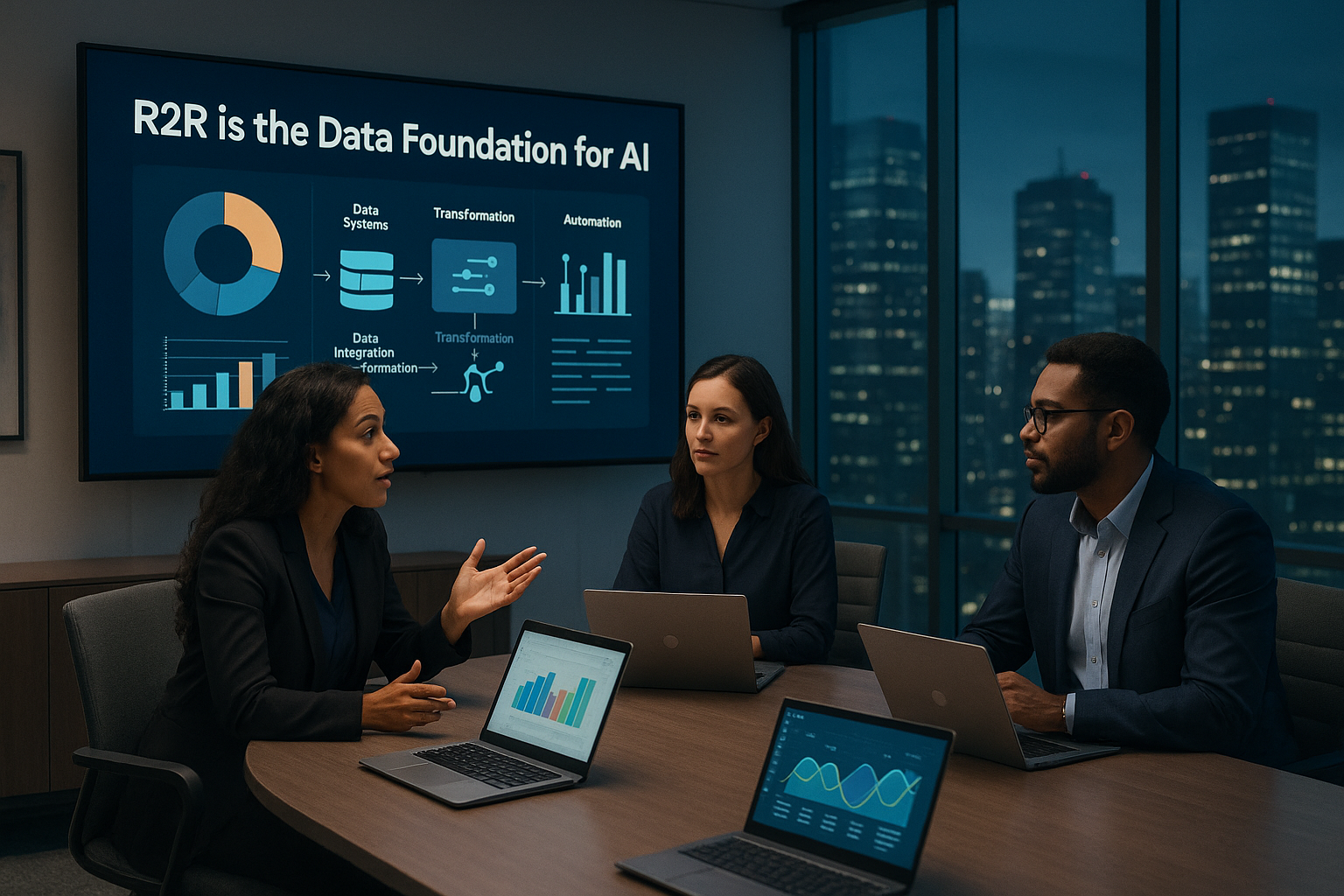
Over the past year, I’ve spoken with dozens of CFOs who are all facing the same mandate:
“Figure out how to leverage AI across the Office of the CFO.”
The pressure is real. Boards want productivity. CEOs want faster reporting. Teams are stretched thin. AI seems like the inevitable solution.
Yet despite the explosion of “AI for Finance” tools, most organizations still aren’t seeing meaningful impact. Significant automation remains out of reach. Insights are shallow or unreliable. And true autonomous workflows feel further away than promised.
After hundreds of conversations, the reason has become clear:
AI in finance isn’t failing because the models are inadequate— AI is failing because the data foundation is inadequate.
In fact, most companies lack the single prerequisite required for AI to actually work:
A reliable, consistent, structured Record-to-Report (R2R) data layer.
Let’s unpack why this matters.
The Problem: Most AI Tools in Finance Are Just ChatGPT Wrappers
Walk the expo floor of any finance or accounting conference today and you’ll see a pattern:
-
AI copilots
-
AI assistants
-
AI contract analyzers
-
AI document parsers
-
AI forecasting widgets
But scratch beneath the surface and you’ll find that most offerings are simply ChatGPT with a UI. They extract text from PDFs. They summarize documents. They answer questions about a spreadsheet.
All useful. None transformative.
These tools don’t solve the core challenge facing modern finance teams:
Your financial data is still fragmented, unstandardized, unreconciled, and often misunderstood by your systems.
No amount of natural language prompting can fix that.
Why AI Can’t Help You Without a Data Foundation
AI is an incredible reasoning engine — but it can’t reason without context. It needs:
-
Structured, reliable data
-
A clear understanding of where truth lives
-
Detailed instructions for each task
Finance teams often assume that AI can magically infer the logic that accountants, analysts, and revenue teams have historically carried in their heads.
But the reality is:
If your Record-to-Report foundation is broken, AI has nothing to reason over.
AI cannot:
-
Reconcile transactions it can’t trace
-
Validate cash flows without audit trails
-
Forecast revenue from inconsistent or missing data
-
Execute tax workflows without structured categorization
-
Automate close steps without data lineage
In other words:
AI is only as smart as the data foundation beneath it.
A More Useful Framework: Think in Jobs-To-Be-Done (JTBD)
When CFOs ask where to start, my recommendation is always the same:
Stop thinking about AI first.
Start with the Jobs-To-Be-Done inside your Record-to-Report process.
Finance is, at its core, a sequence of jobs:
-
Record operational events
-
Transform them into financial meaning
-
Reconcile discrepancies
-
Generate statements, forecasts, and reports
If you define these jobs clearly — and if your data foundation supports them — then AI becomes powerful.
But if you skip this step, AI becomes guesswork.
A Helpful Analogy: AI as Thousands of Tireless Co-Workers
Imagine AI as a team of highly skilled co-workers who can run tasks 24/7.
They can:
-
Collect cash
-
Categorize transactions
-
Validate tax exposure
-
Run variance analyses
-
Produce scenarios
-
Generate reconciliations
But they can only do their job if:
-
The instructions are detailed
-
The data is trustworthy
-
They know exactly where to look for answers
Today, most organizations are trying to hire these “AI co-workers” before giving them an employee handbook.
That’s why results fall short.
The Record-to-Report Layer Is the Foundation for that will drive AI innovation
Once you establish a clean R2R data foundation — ideally automated, consistent, and source-of-truth oriented — everything changes.
Suddenly, AI agents can:
1. Seek financial truth
They know where your source-of-truth revenue, expenses, cash, and balance information live.
2. Validate data autonomously
The audit trail is clear. Lineage is preserved. Reconciliations are explicit.
3. Execute workflows end-to-end
Close steps, sub-ledger processes, and reporting tasks become automatable.
4. Drive higher-order intelligence
Forecasting, scenario modeling, real-time KPIs, and anomaly detection become dramatically more accurate.
This is how AI truly transforms the Office of the CFO — not through point tools, but through foundations.
Why Leapfin Is Evolving Into the Intelligence Layer for Record-to-Report
At Leapfin, we believe the R2R foundation is the most critical (and most overlooked) component of AI transformation in finance. A unified, trustworthy data layer that:
-
Normalizes operational data
-
Applies accounting logic consistently
-
Generates structured financial truth
-
Powers downstream systems and AI agents
In a world where AI will execute thousands of finance jobs autonomously,
The companies with the strongest data foundation will win.
You cannot bolt AI onto a fragmented financial ecosystem.
You must build the right data infrastructure first.
See how Leapfin works
Get a feel for the ease and power of Leapfin with our interactive demo.